SAAM II™ — the reference compartmental modeling suite.
Lightweight and purpose-built for the systems you model.1 Independent reviewers have called it "excellent".2
SAAM II is a specialist environment for rapid, exploratory modeling in pharmacology, physiology, dosimetry, and translational development — backed by decades of scientific use and published case studies.
SAAM II has been evaluated in peer-reviewed studies and used in modeling workflows that have supported drug and research development programs. Regulatory use depends on each user's validation, documentation, intended use, and quality system.
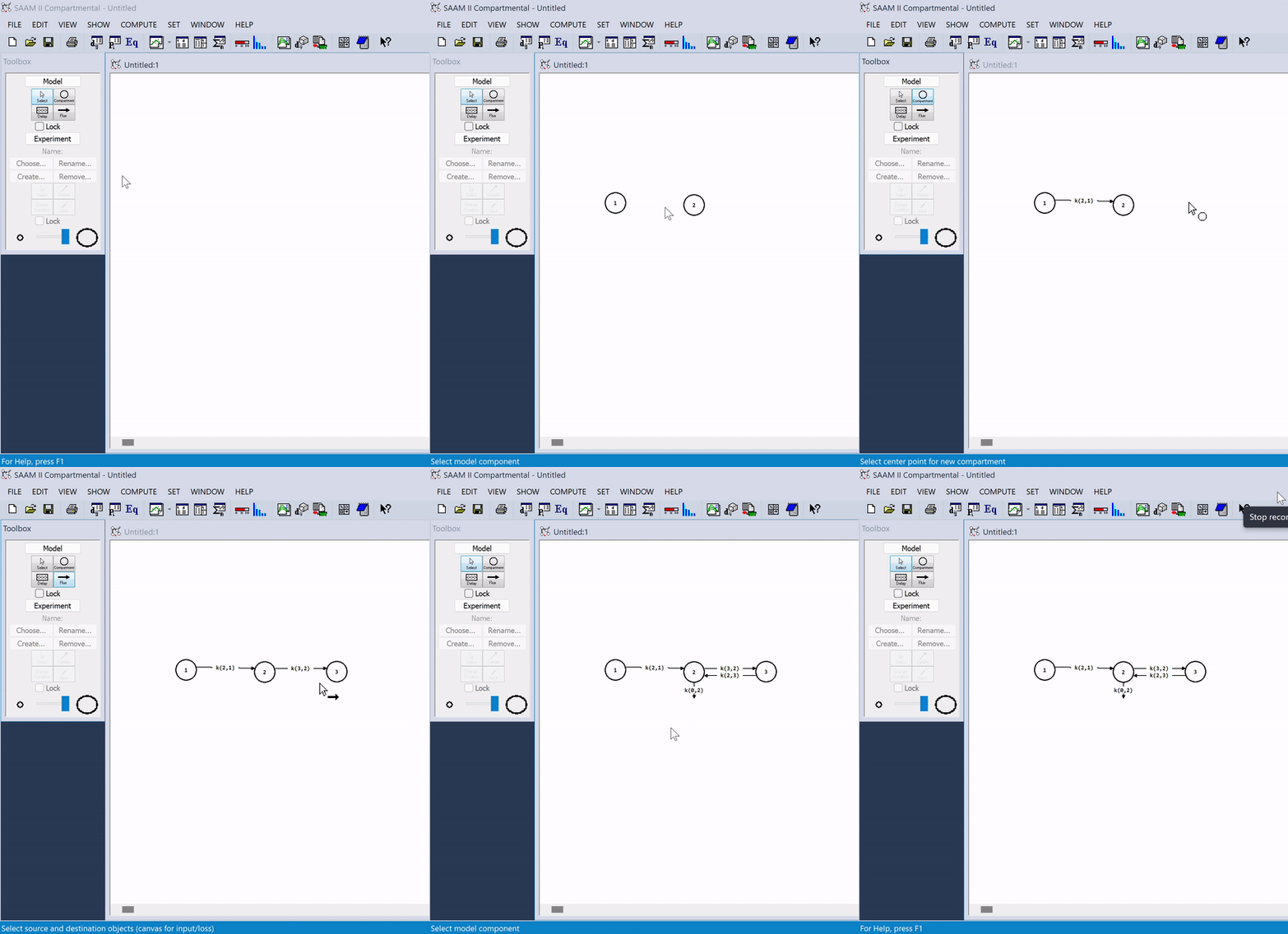
Build models the way you think
Sketch compartments, fluxes, and delays in the graphical workspace — directly from your notes or mental model. Click run to simulate, or fit to find the best parameters for your data. SAAM II handles the differential equations, numerics, and estimation.
Capabilities
SAAM II 2.5 (2026) runs as standalone Windows software. Your data never leave your machine. PopKinetics is included free on request.
By the numbers
Impact · Adoption · SupportPublications per year
* Publications from PubMed research using "SAAM II", "SAAM2", or "SAAM" keywords, including conference abstracts, theses, and patents (accessed May 2026, filtered by year).
Adoption & support
* 99% user loyalty and 1-day support reply measured by internal review 2022–2025.
Featured publications
Selected · Peer-reviewedSAAM II: Simulation, analysis, and modeling software for tracer and pharmacokinetic studies
Barrett PHR et al.
Read paper →What's new
2025–2026Nanomath at PAGE 2025
Meet the team at the Population Approach Group in Europe meeting — Greece.
SAAM II powers AOMM™
A peer-reviewed study validates batch-mode OGTT analysis — now integrated into AOMM™.
Version 2.5
Bug fixes and UI polish — shipping soon.
Resources
Tutorials · Library · CommunityTutorials
Step-by-step PDF guides for compartmental modeling, advanced features, and numerical workflows.
- Compartmental modeling
- Advanced compartmental
- Modern examples (files + paper)
- Numerical methods
- PopKinetics tutorial paper
Browse all tutorials →
PopKinetics
Two-stage population-PK analysis add-on for SAAM II — free with your license.
Requires SAAM II.
Download PopKinetics Download documentation (PDF) Download tutorial files
Community & external
Workshops, societies, and third-party resources where SAAM II is taught and used.
SAAM II's history
1950s–today · NIH origins
1950s
SAAM origins at NIH
Dr. Mones Berman at the NIH Mathematical Research Branch develops compartmental modeling for radiation dosimetry, creating the Simulation, Analysis and Modeling (SAAM) language — a flexible "modeling dictionary" for translating sketched compartmental diagrams into systems of differential equations.
Late 1970s
CONSAM
Conversational SAAM (CONSAM) led by Prof. Roy Boston launches with a command-line interface, enabling interactive modeling on graphical terminals like the Tektronix 4010 and 4025 — replacing the punch-card workflow.
1982–1988
RFKA at the University of Washington, Seattle
UW's NIH-supported Resource Facility for Kinetic Analysis (RFKA) becomes an international hub for biomedical, metabolic, and pharmacological modeling, sponsoring workshops and supporting visiting researchers worldwide. SAAM II was conceived here with key input from compartmentalists like JA Jacquez (Michigan), C Cobelli (Padova), and J DiStefano (UCLA).
1993
SAAM II released
The complete redesign — drag-and-drop GUI, modern numerical and statistical algorithms — ships first on Sun workstations, with the PC version following shortly after.
1995–2005
SAAM Institute era, Seattle
The SAAM Institute becomes a worldwide reference in PK and modeling, hosting workshops and visiting scientists who shaped modern PK and PD. The Institute also released PopKinetics, a two-stage population-analysis add-on. The center was led by D Foster and P Vicini (UW).
2008
FDA milestone — Padova–UVA simulator
The Padova–UVA Type 1 diabetes simulator, designed in SAAM II, is accepted by the FDA in lieu of animal trials — a landmark recognition of in-silico testing for closed-loop insulin delivery research.
2012-2022
The Epsilon Group / Abbott
The Epsilon Group (later acquired by Abbott, Charlottesville, VA) licenses the commercial rights to maintain and distribute SAAM II.
2022-now
Nanomath stewardship
SAAM II transfers to Nanomath LLC (Spokane and Seattle) — the current developer and distributor under the leadership of Simone Perazzolo. Latest release: SAAM II 2.5 (2026).
Next
Working on the next versions
Exciting new capabilities are in development — stay tuned for what's coming next to SAAM II.
References
Citations- [1] Perazzolo S. SAAM II: A general mathematical modeling rapid prototyping environment. CPT Pharmacometrics Syst Pharmacol. 2024. ↩
- [2] Charles BG, Duffull SB. Pharmacokinetic software for the health sciences. Clin Pharmacokinet. 2001. ↩
- [3] Vasić V et al. A PBPK model for PRRT with [177Lu]Lu-DOTA-TATE: Comparison of model implementations in SAAM II and MATLAB/SimBiology. Phys Med. 2024. ↩
- [4] Barrett PHR et al. SAAM II: Simulation, analysis, and modeling software for tracer and pharmacokinetic studies. Metabolism. 1998. ↩
- [5] Heatherington A et al. A pharmacokinetic/pharmacodynamic comparison of SAAM II and PC/WinNonlin modeling software. J Pharm Sci. 2001. ↩