In collaboration with the TLC-ART program · University of Washington
CS-BLAP — classification system for long-acting products
A focused consulting service for pharma and biotech teams developing long-acting (LA) drug products — injectables, implants, and depot formulations. We bring mechanistic modeling, IVIVC expertise, and regulatory experience to every stage of LA development.
LA pharmacology & modeling
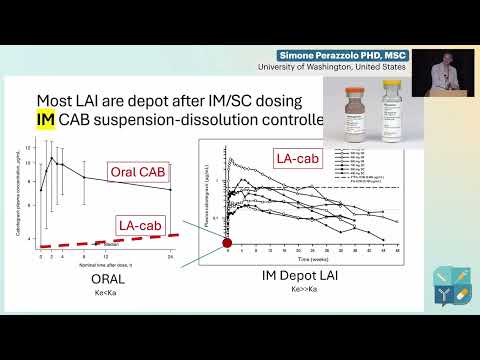
Mechanistic PK/PD models for subcutaneous and intramuscular long-acting injectables, depot formulations, and implants. We build from release-rate characterization through systemic exposure prediction across multi-month dosing intervals — connecting formulation parameters directly to clinical outcomes.
LA IVIVC & flip-flop
In vitro–in vivo correlation development for long-acting systems, including flip-flop PK identification and deconvolution. We design the release experiments that give predictive power, and build IVIVC models that hold across formulation variants and species.
LA classification system
Biopharmaceutical classification frameworks adapted for long-acting products — mapping release rate, solubility, absorption window, and target tissue distribution into actionable development decisions. Use it to triage formulation candidates early and guide the IND strategy.
LA NAM integration
New approach methodology integration for long-acting product development: in silico absorption models, physiologically-based biopharmaceutics, and organ-on-chip data translation. Reduce animal studies and improve mechanistic confidence at the IND stage.
Lymphatic system PBPK
Physiologically-based pharmacokinetic models that explicitly account for lymphatic uptake and transport of long-acting nanoparticle formulations. After intramuscular or subcutaneous injection, drug-loaded nanoparticles are taken up by local macrophages and trafficked through lymph nodes before reaching the systemic circulation — creating a secondary depot with distinct release kinetics that classical PK models miss entirely.
Our PBPK framework captures injection-site dynamics, lymph-node retention, thoracic duct drainage, and free-drug redistribution in a single mechanistic model — enabling quantitative prediction of the lymphatic contribution to LA exposure and its implications for dosing interval design.
Perazzolo et al. J Pharm Sci 2022 · Part I — Free-drug mixture & the lymphatic system →
Engage with us
Tell us about your LA product, the development stage you're at, and the decision you need the model to support. We'll get back within one business day with a scoping conversation.