AOMM™ Science · White paper 01
Also in this series: White paper 02 — Platform (coming soon)
Computing oral minimal model indices is no longer a bottleneck.
AOMM™ is a program that runs on your laptop and keeps your data there. It has been validated on historical and new data, across small and large cohorts — T1D, T2D, IGT, normoglycemia, and more. It recovers insulin sensitivity and β-cell responsivity (and the disposition index) from OGTT and MMTT tests in batch. The indices were previously validated against clamps/tracers for Si and insulin secretion. Based on the SAAM II architecture.
Why is AOMM™ important?
Minimal model indices are among the most physiologically grounded approaches for assessing insulin sensitivity and β-cell function, but they remain difficult to compute reliably. In practice, the analysis often requires:
- A data scientist or modeling expert to perform the analysis
- An experienced modeler to review, troubleshoot, and validate the results
- Specialized software such as SAAM II, or a custom implementation that may not be standardized or independently validated
As a result:
- Results may vary across implementations, limiting reproducibility and confidence in multicenter studies and clinical trials
- The analysis may be too time- and resource-intensive for routine use, leading teams to rely on simpler indices that can lose physiologically meaningful information
It’s like having a sports car that no one can drive — so you show up to the race in an easier one.
Claim. AOMM™ puts the physician in the driver’s seat of powerful physiological modeling.
What do you need?
Take your spreadsheet test results and input them into AOMM™.
- OGTT / MMTT. Glucose amount in grams or g/kg (e.g., 75 g).
- Timeline. Accepts all test timepoints — 5, 7, … n points in the −30 to 420 min range. Custom timelines are accepted.
- Analytes. Glucose, insulin, and C-peptide for the full model run.
- Demographics. Test ID, body weight (BW), BMI, and age at visit.
How does it perform at scale?
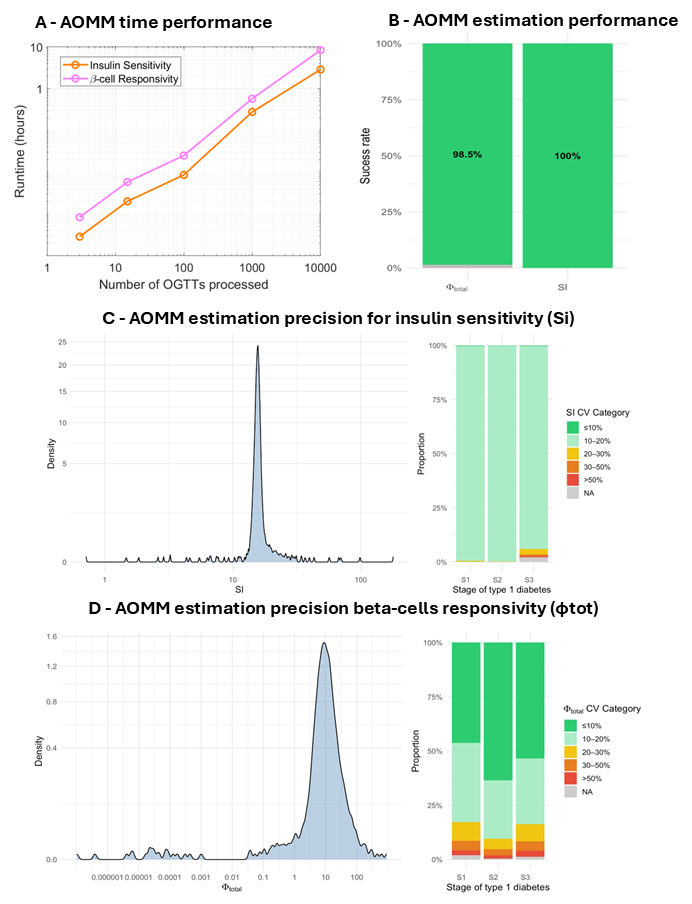
AOMM™ performs well at scale: about one test per second, up to ~10k tests in a run. In a TrialNet cohort of 10k+ OGTTs, success rates were >98% for extracting insulin sensitivity and β-cell secretion indices.
Architecture
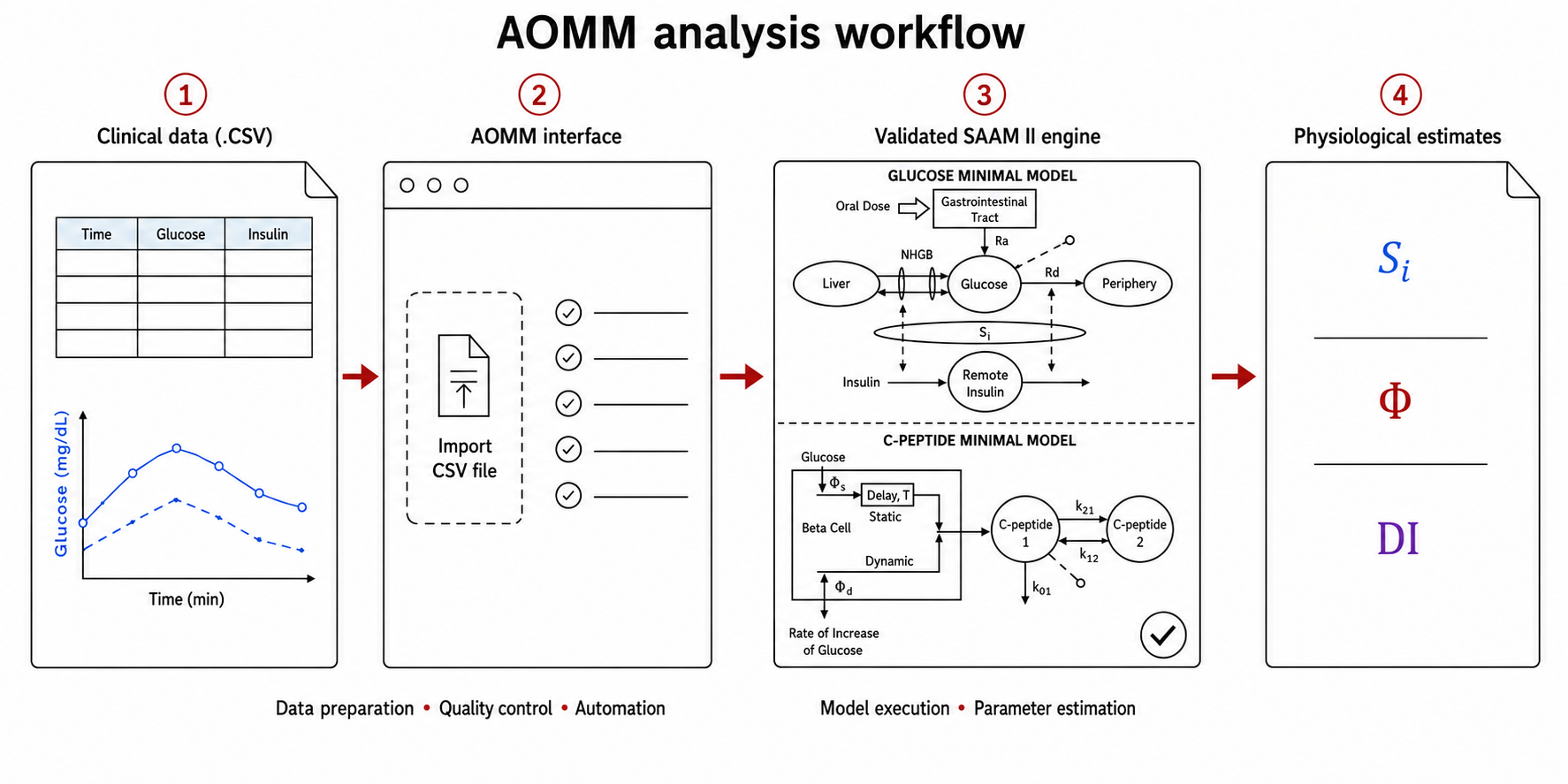
AOMM™ takes clinical OGTT/MMTT data from a spreadsheet, runs quality-controlled batch preparation, executes the validated SAAM II oral minimal-model engine, and returns physiological estimates — insulin sensitivity (Si), β-cell responsivity (Φ), and the disposition index (DI).
Acknowledgements
Breakthrough T1D, TrialNet, C-path, A Carr and P Senior U Alberta, A Gladerisi Yale, C Cobelli Padova, C Dyan Cardiff U.