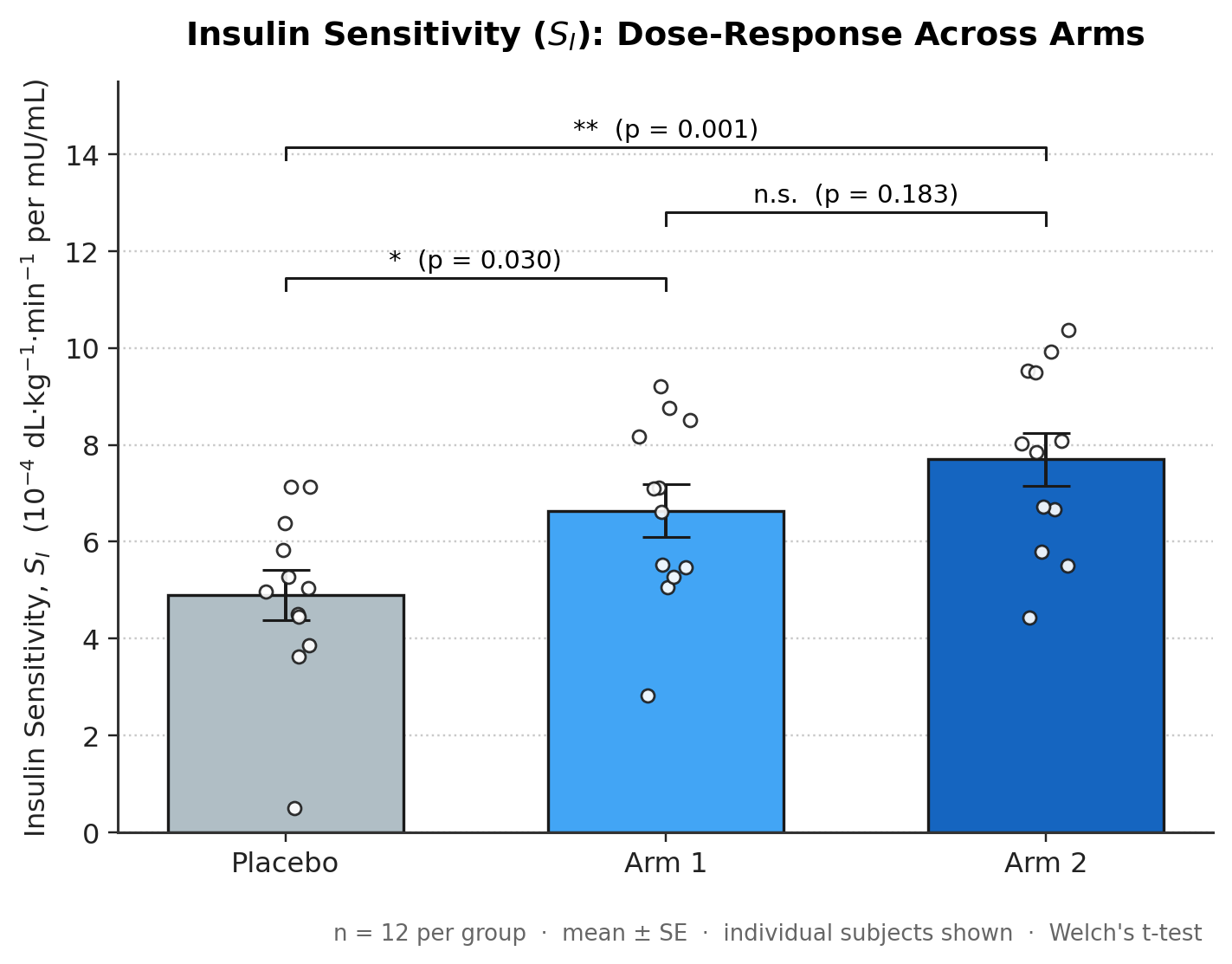
Mechanistic trial readouts from OGTT/MMTT runs.
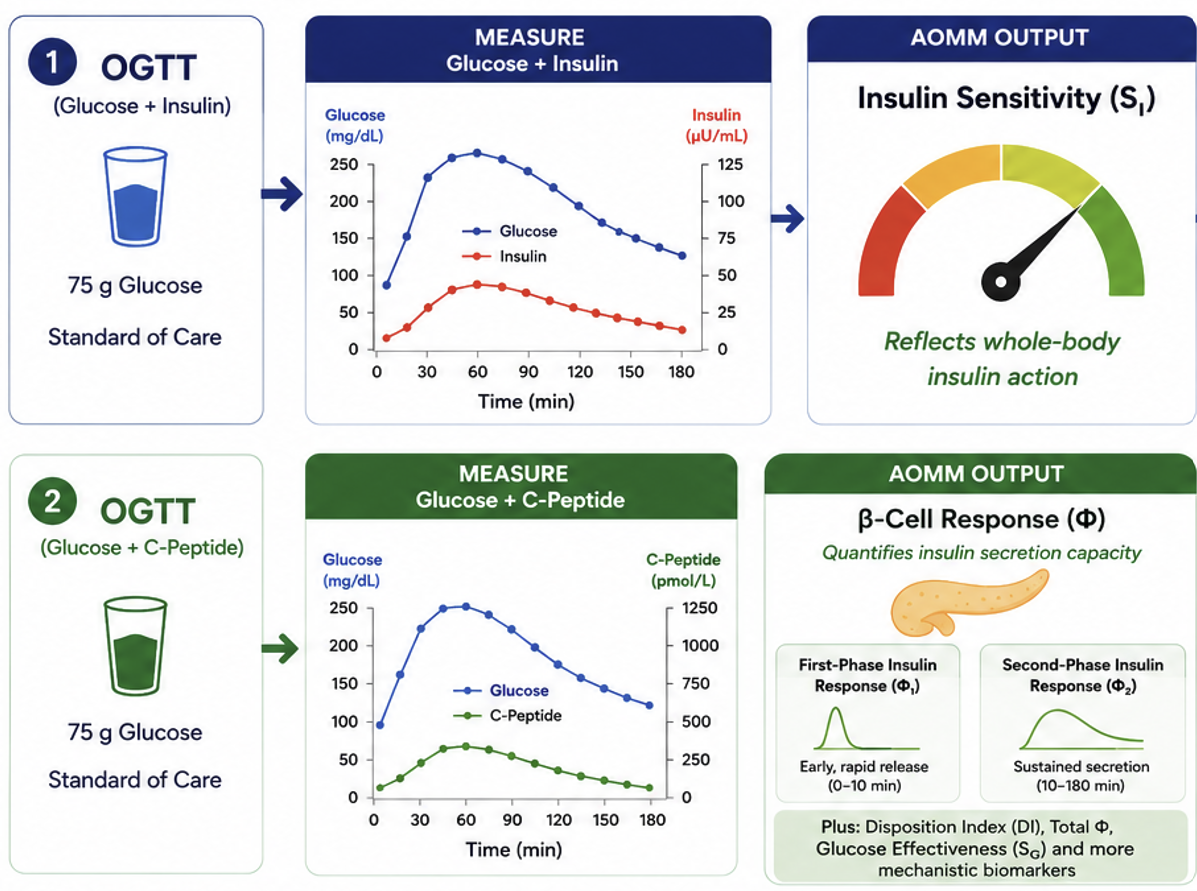
AOMM provides a single, reproducible and validated workflow to calculate mechanistic metabolic biomarkers for clinical trials and research. See whether a therapy is working, why, and which patients benefit or progress—months before glycemic endpoints move.
Registered trial endpoints
ClinicalTrials.gov · OMM / AOMMTrials with prespecified endpoints derived from the oral minimal model (OMM) or automated OMM (AOMM) analysis of OGTT or MMTT data.
★ Recently registered on ClinicalTrials.gov
Prespecified metabolic measures from OGTT or MMTT data — complementary to glycaemic, hormonal, imaging, and clinical endpoints.
Trial evidence
Published · Real cohortsBaseline secretion separated responders before progression
Abatacept didn't work in T1D using standard CT design. However, when patients were grouped by AOMM insulin secretion (Φ), one subgroup did respond with stat significant delay in T1D onset.3
Distinct metabolic phenotyping visible by AOMM metrics
β-cell function indices distinguished Stage 1 and Stage 2 signatures ahead of diagnosis.4
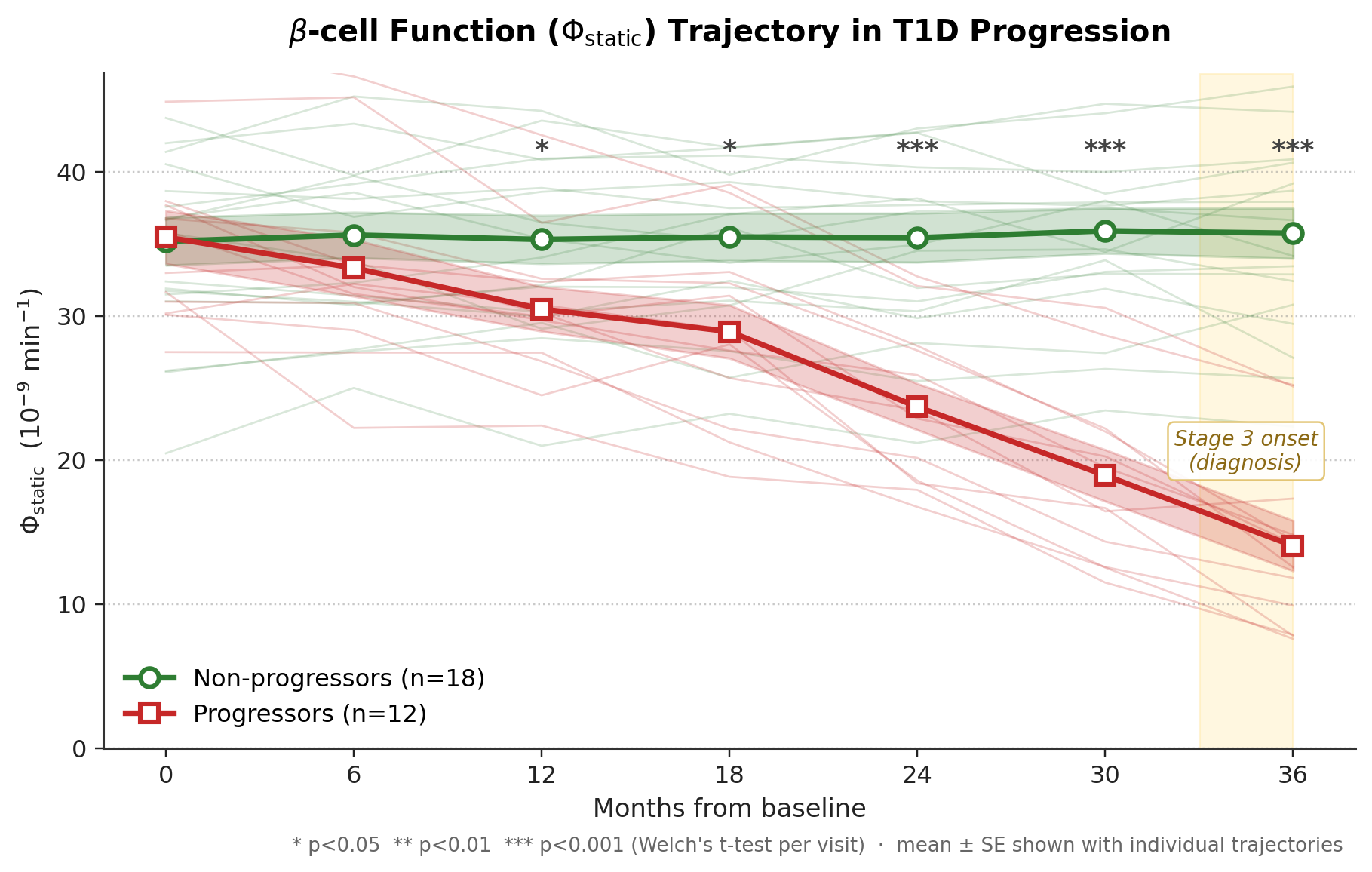
β-cell trajectory tracked disease modification
Natural history of decline alongside teplizumab response in Stage 2 T1D.5
Beyond surrogate indices
HOMA-IR · Matsuda · fasting proxies vs. AOMMHOMA-IR · Matsuda · single fasting proxy
- One static snapshot; no secretion dynamics
- Cannot separate first- from second-phase response
- No disposition index — sensitivity and secretion not linked
- Blind to incretin-mediated first-phase restoration
AOMM
- Uses the full dynamic OGTT/MMTT trajectory
- Dynamic vs. static secretion resolved separately
- Clamp-validated Sᵢ and a true DI in one panel
- Per-subject precision (QC) on every index
What is AOMM?
AOMM extracts mechanistic, model-based metrics from OGTT and mixed-meal tests, including insulin sensitivity, β-cell responsivity, and disposition indices. Built on the Cobelli framework1 and powered by SAAM II, it automates data preparation, batch analysis, quality control, and standardized reporting for clinical research.
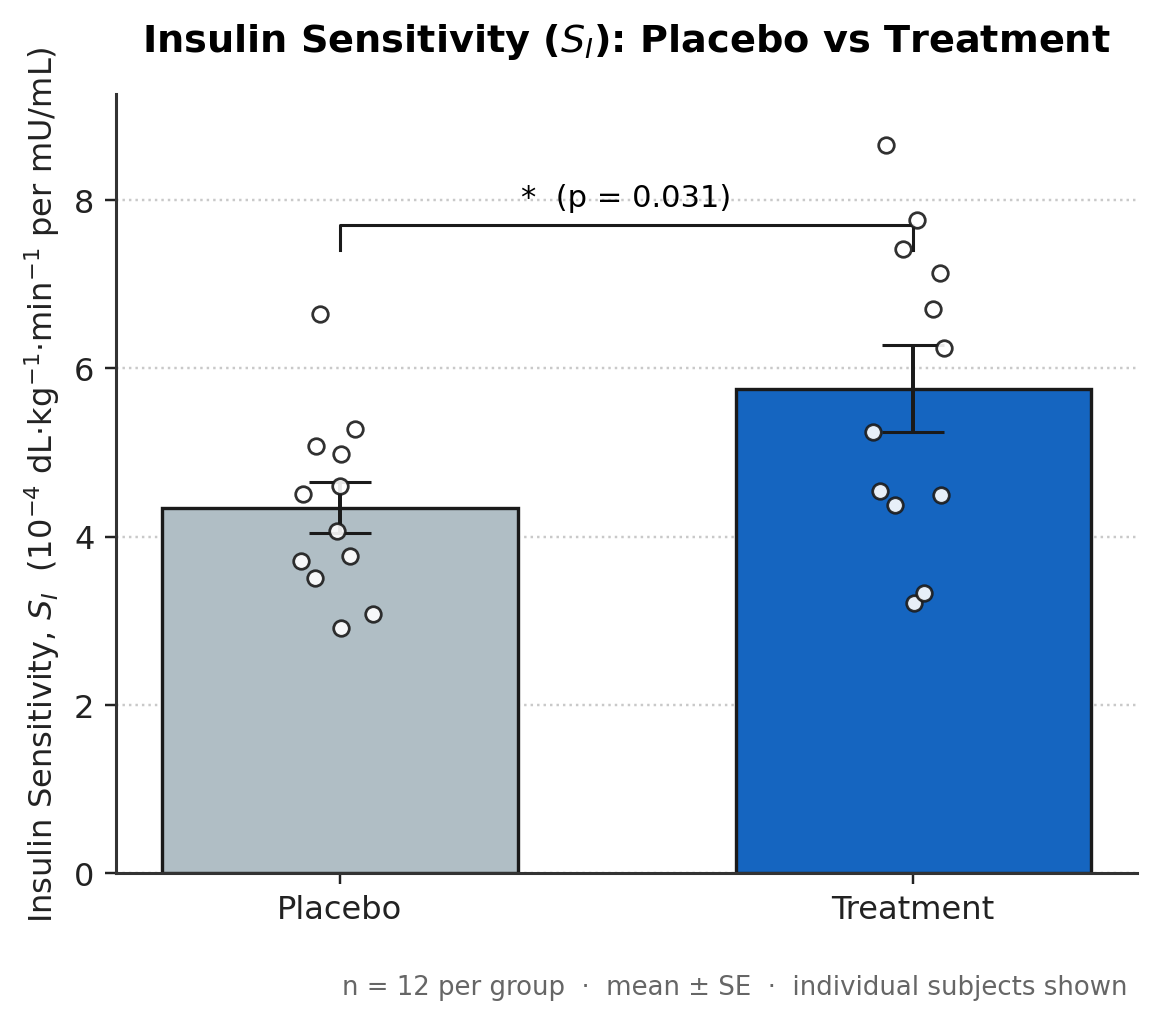
- Sᵢ — whole-body insulin sensitivity
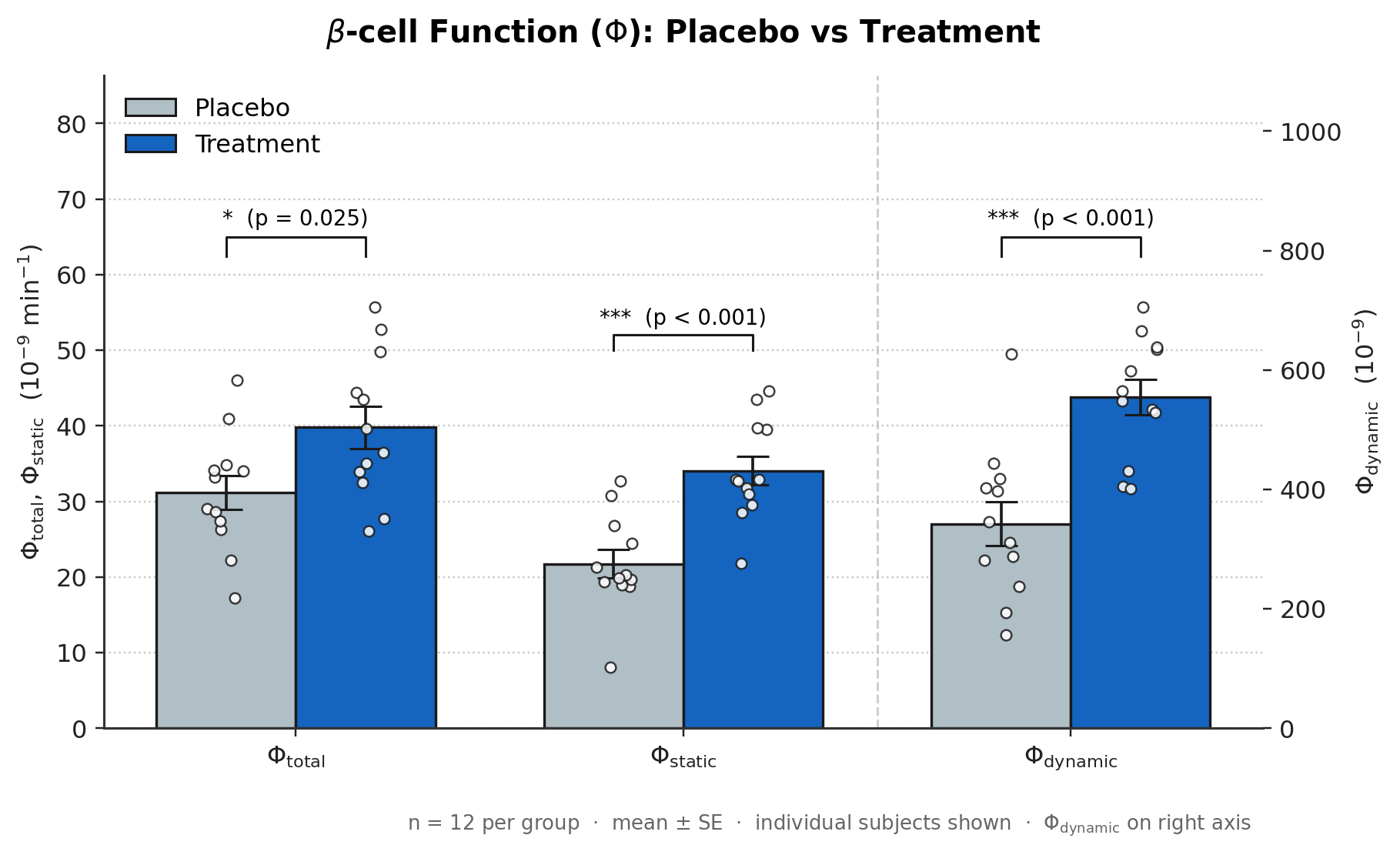
- Φ_total, Φ_static, Φ_dynamic, T — β-cell function indices
- DI — disposition index
- Speed — 1 test per second
- QC — precision of indices provided
- Validation (for accuracy) — against tracer and clamp reference (gold-standard)2
- Validation (for scale) — across 15k+ OGTTs (presented at ATTD 2026)
What is needed
Expected input from a sponsor:
- Concentration-time dataGlucose, insulin, C-peptide
- Subject covariatesAge, BMI, body weight
- OGTTGlucose challenge dose
- MMTTCarbohydrate (CHO) content
Method & validation publications
Automated Oral Minimal Models for rapid estimation of insulin sensitivity and β-cell responsivity in large-scale data sets
Perazzolo S, Galderisi A, Carr A, Dayan C, Cobelli C.2
Advisors, sponsors & collaborators
Scientific · Clinical · IndustryCurrent scientific advisors
Scientific advisors
- Colin Dayan — University of Birmingham · immunology and clinical endocrinology
Technical advisors
- Claudio Cobelli — University of Padova · originator of the oral minimal-model framework
Clinical collaborators
- Alfonso Galderisi, MD — Yale University · clinical validation in T1D and pediatric cohorts
Data science support
- Alice Carr — University of Alberta · data science and clinical research
- Peter Senior — University of Alberta · data science and clinical research
Regulatory support
- Joseph Hedrick — Critical Path Institute (C-Path) · regulatory strategy and biomarker qualification
Sponsors
- Breakthrough T1D — funded clinical validation and scale-up of AOMM metrics in T1D trials
References
Citations- [1] Cobelli C et al. The oral minimal model method. Diabetes 2014;63(4):1203–13. ↩
- [2] Perazzolo S et al. Automated Oral Minimal Models for rapid estimation of Sᵢ and β-cell responsivity. J Diabetes Sci Technol 2025. ↩
- [3] Galderisi A et al. Baseline insulin secretion determines abatacept response in Stage 1 T1D. Diabetes 2026;75(2):229–240. ↩
- [4] Galderisi A et al. Metabolic phenotype of Stage 1 and Stage 2 T1D. J Clin Endocrinol Metab 2025;110(11):3168–78. ↩
- [5] Galderisi A et al. β-cell function and insulin clearance trajectory in Stage 2 T1D — natural history and teplizumab response. Diabetologia 2024. ↩